Colleges in Vermont
Why go to College in Vermont?
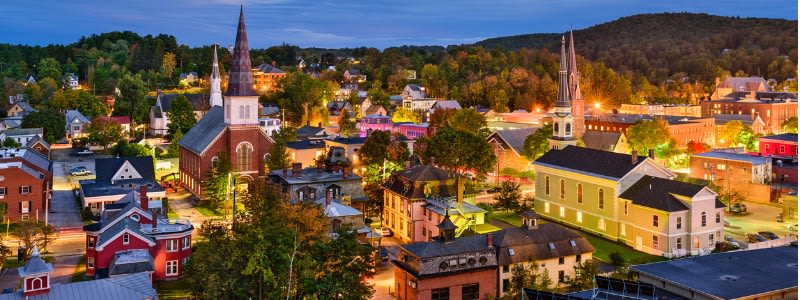
Vermont is one of the smallest states in the country, but has many prestigious colleges, such as Middlebury and Bennington. Whether you're interested in campus programs or online colleges in Vermont, this guide provides everything you need to know about higher education in this New England state.
What Options are Available for Colleges in Vermont?
On-Campus
If you have the time and availability to commit to regular campus visits, classroom courses might be a preferable option, especially if you benefit from structure and hands-on guidance. Campus courses are typically more active, and being present in a classroom draws more participation and engagement from many students. As a campus student, you also take advantage of the support of classmates and the larger campus community, along with facilities and on-campus resources, such as tutoring services, computer centers, and academic and career counselling services. While these resources are generally available to online students, they may be more easily accessible on campus.
Online Programs
Whether you live far from a college or have work and family obligations, there are plenty of reasons you might choose to enroll at one of the many online colleges in Vermont. With an online program, you can fit your education around your life, completing classwork when it's convenient.
While online learning is typically more flexible than campus study, it does come with certain challenges. Some online courses include scheduled virtual class meetings, but most commonly, courses are taught asynchronously, requiring you to complete coursework independently. Self motivation is an important characteristic for online learners to have.
Hybrid Programs
Hybrid programs allow you to take a mix of classroom and online courses, combining the engagement of classroom learning with the convenience of distance education. Some degrees may offer certain courses in a specific format, while others (often at larger schools) allow you to take any combination of courses in any format. There are fewer options for online courses, particularly electives, but schools are constantly updating their course catalogs with new online offerings.
Popular Degree Programs in Vermont
Vermont's most popular degree choices are environmental science and English. This indicates that many Vermont students are more concerned with expanding their knowledge than building technical or vocational skills.
Environmental Science Environmental science applies scientific principles to the study of the natural environment, developing solutions to problems like pollution, climate change, and overpopulation.
English Language and Literature English students examine and interpret literary texts, placing works in an aesthetic, historical, cultural, and political context. Vermont is home to several prominent liberal arts colleges that host respected English programs, including Bennington, Middlebury, Goddard, and Marlboro.
What are the Best Online Colleges in Vermont?
This list is intended to help you understand your options as you explore the best online colleges in Vermont. The schools in this ranking are all fully accredited, academically respected, and home to flexible online learning programs, allowing you to earn a degree without putting your life on hold. The list covers online schools in Vermont that offer different degree levels, including bachelor's and graduate programs.
Top 3 Online Colleges in Vermont for 2019

Admissions Rate
66%
Graduation Rate
58%
Online Enrollment
44%
Retention Rate
79%
Default Rate
5%
A private college overlooking Burlington, Champlain focuses on career-driven higher education programs that prepare students for a competitive job market. Prospective students seeking to complete their studies online have several options including bachelor's degrees in accounting, business management, software development, and integrated studies. The programs are delivered fully online in an asynchronous format.
One of the top online colleges in Vermont, Champlain has a generous transfer policy and accepts up to 90 transferable credits. Students can also earn credit for military experience. Admission into one of Champlain's programs requires a high school diploma or equivalent, a minimum GPA of 2.5 in prior coursework, and an aptitude for success in an online learning environment.
Visit SiteSponsored
What are the Best Online Community Colleges in Vermont?
Cheaper than four-year colleges and universities, community colleges typically offer associate degrees that focus on vocational skills. They usually take two years to complete, allowing you to quickly enter the workforce with minimal time spent in school. An associate degree can also serve as the first half of a four-year degree. Many two-year programs fulfill the general education requirements of bachelor's degrees.
Top Online Vermont Community Colleges

Admissions Rate
19%
Graduation Rate
21%
Retention Rate
15%
Default Rate
51%
CCV operates 12 campuses across the state, creating an extensive network of online community colleges in Vermont. Offering study abroad programs, internships, professional field experiences, and community service opportunities, the school focuses on experiential learning. CCV also provides several online programs , almost all of which can be completed fully online.
CCV's online associate degrees include STEM studies, early childhood education, and criminal justice. Online certificate programs include medical billing and coding, website design, bookkeeping, and substance abuse services. CCV offers its students a generous transfer policy. Through the college's Vermont State Colleges Direct Admission Program, students are guaranteed transfer admission to Castleton University, Vermont Tech, or Northern Vermont University, where they can choose from a large selection of bachelor's programs.
Visit SiteSponsored
How We Ranked the Schools
To determine the best programs, we looked at the most important factors prospective students, mainly common predictors of future success and a school's commitment to online programs. This boils down to admissions rate, student loan default rate, retention rate, graduation rate, and the percent of students enrolled in online classes. All data points are taken from information provided by colleges and universities to the National Center for Education Statistics.
Each factor is weighted evenly in order to give an objective view and determine the best online master's in management information systems programs. To calculate our rankings, we looked at a school's ranking when organized by a single factor, and then averaged each category's ranking to find an overall score: Admissions Rate (20%) + Default Rate (20%) + Retention Rate (20%) + Graduation Rate (20%) + Percent of Students Enrolled in Online Classes (20%) = Final score.
Education Trends in Vermont
Vermont spends less than the national average on higher education, allocating less per pupil and a much smaller percentage of tax revenue overall. Despite reduced education spending, citizens of Vermont are more educated than average Americans in every category, boasting higher rates of attainment at the associate, bachelor's, and graduate level.
| Vermont | United States | |
|---|---|---|
| Postsecondary Education Spending per Full-Time Student | $2,818 | $6,954 |
| Percent of Tax Revenue Allocated to Higher Education | 2.6% | 5.8% |
| Percentage of adults over 25 with associate degree | 8.4% | 8.1% |
| Percentage of adults over 25 with bachelor's degree | 21.7% | 18.5% |
| Percentage of adults over 25 with graduate degree or higher | 14.3% | 11.2% |
| Source: SHEEO and U.S. Census | ||
Paying for College in Vermont
Tuition is one of the major determining factors for where students attend college, and this is particularly true in Vermont, where tuition rates at public two- and four-year colleges are higher than the national average. It's important to compare the prices of different schools and consider your financial aid options.
Tuition Prices
The chart below compiles average in-state tuition rates for public colleges in Vermont. These figures don't include any of the other costs typically associated with higher education, including textbooks, transportation, and housing.
Financial Aid
Whether you're applying to online colleges in Vermont or any other state, one of your first steps should be to fill out the FAFSA, which provides you access to financial aid opportunities. If you're eligible, grants and scholarships are always the best funding options since they don't have to be repaid. Federal loans are preferable to private loans, because they typically offer lower interest rates and more generous repayment plans. Private loans usually offer less flexible repayment options.
Cost for Online Programs in Vermont
Student can obtain financial aid whether they attend on-campus or online schools in Vermont. Online programs are usually the same price as campus programs (some may even be cheaper), and they also allow you to save on some expenses, such as transportation, childcare, and sometimes books. Renting online textbooks, which are often available at a discounted price, is another way to cut down on the cost of school.
Scholarships for Vermont College Students
Can all Scholarships be Used for Online Programs?
While most scholarships are applicable to campus programs and online colleges in Vermont, some may have unique requirements that make them unavailable to online students, such as campus residency. Before applying for a scholarship, be sure to check with the school or organization to ensure that online students are eligible for the award.
Employment Outlook in Vermont
Vermont boasts one of the lowest unemployment rates in the country, nearly a full percentage point lower than the national average. And while the state's annual mean wage is slightly lower than the national average, the high rate of employment makes it possible to find a job with a competitive salary. Finance, education, healthcare, and government rank as some of the top industries in the state, and Vermont is also home to a large manufacturing sector, with many companies, like IBM, operating manufacturing plants within the state.
| Vermont | United States | |
|---|---|---|
| Unemployment Rate, May 2017 | 3.0% | 4.3% |
| Annual Mean Wage, May 2016 | $47,620 | $49,630 |
| Source: BLS and BLS | ||
Top Employers and Industries in Vermont
Top Industries in Vermont
Finance, insurance, real estate: Occupying about 20% of Vermont's economy, this broad industry encompasses banking and other financial services, all types of insurance, and real estate.
Government: Government work is about 15% of Vermont's GDP, which is a bit higher than the national average. This industry includes government agencies, political offices, and other state services.
Education services and healthcare: Education and healthcare account for 13% of Vermont's GDP and contribute the most to real GDP growth.
Top Employers in Vermont
State Exchange Programs for Vermont College Students
There are plenty of options for on-campus and online schools in Vermont, but the state also offers exchange programs that allow you to attend college in neighboring states while still paying in-state tuition. These state programs allow you to become an in-state student outside of your state of residence—some temporarily and some for the duration of a program.
The New England RSP allows students to choose between 82 colleges in the region, paying a reduced tuition rate as long as students pursue a major that is not offered at a public school in their home state.
Eligible States: Connecticut, Maine, Massachusetts, New Hampshire, Rhode Island
Cost of Living by Region
Most online schools in Vermont have a tuition that is higher than the national average, which makes it important to choose a college where the cost of living is low. While larger urban centers like Burlington have a higher cost of living, many of Vermont's colleges are found in smaller towns, such as Bennington, which offer much lower rental and home buying prices. The following chart compiles rent and home prices for several cities in the region.
Accreditation for Colleges in Vermont
Whether you're researching online colleges in Vermont or any other state, it's always important to determine an institution's accreditation status, particularly for online schools, where the risk of fraudulence runs higher. Accreditation indicates that a school has been examined by a professional accreditation organization and meets professional standards.
The two most common forms of accreditation are regional and national. Regional accreditation is generally reserved for academic four-year colleges that offer bachelor's degrees, while national accreditation is awarded to professional and vocational schools that offer career-oriented associate degrees. While one type of accreditation isn't necessarily "better" than another, they do indicate different standards for schools, and it's typically more difficult to transfer credits from a nationally accredited institution to a regionally accredited one.
Online programs are held to the same accreditation standards as campus programs. When researching different programs, whether online or campus, it's a good idea to consult the Council for Higher Education Accreditation database, which keeps track of nearly all the country's major accreditation organizations.
Resources for Students in Vermont
Consortium of Vermont Colleges: A committee of the Vermont Higher Education Council, the consortium promotes higher education diversity and opportunities in the state, helping students connect to different schools and programs.
Vermont Student Assistance Corporation: VSAC helps students save, plan, and pay for higher education and other vocational training, awarding grants and scholarships and offering affordable private loans for education.
Vermont Education: The state's official website offers information on colleges, continuing education and training programs, financial aid, education organizations, and other resources for college students.
State of Vermont Agency of Education: The Agency of Education's website offers resources and listings of colleges in state and out of state that are certified to offer degrees in Vermont.
Vermont Higher Education Investment Plan: Vermont's 529 college savings plan helps parents and students pay for college education through savings and investment. The site also offers financial planning resources and other tools to help families prepare for college.