Colleges in Iowa
Why go to College in Iowa?
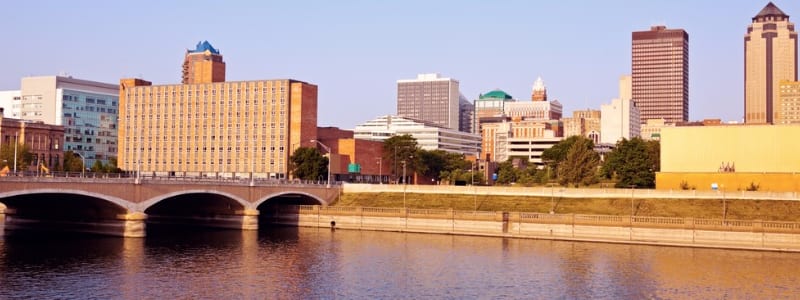
On-campus and online colleges in Iowa offer affordable, personable, and competitive educational experiences. From Iowa's small, private schools to its Big Ten powerhouse, the University of Iowa, the state offers some of the strongest academic institutions in the nation. With more than 60 colleges and universities, Iowa is home to leading agricultural programs and the oldest land-grant institution in the nation, Iowa State University.
What Options are Available for Colleges in Iowa?
On-Campus
On-campus programs in Iowa offer two- and four-year degrees to local, out-of-state, and international students. With low student-to-teacher ratios in many of Iowa's institutions, students benefit from close interaction with instructors and peers. Even Iowa State, one of the biggest schools in Iowa, has a 19:1 student-to-faculty ratio. Iowa State has a 69% graduation rate, and 50% of undergraduates at the University of Iowa graduate within four years.
Online Programs
Online schools in Iowa offer two- and four-year degrees. Distance learning options provide flexible educations, while maintaining rigorous academic standards. Upper Iowa University offers three bachelor's of arts concentrations as online degrees and more than two dozen bachelor's of science options. Iowa State offers an online liberal studies degree that allows students to focus on one field or to incorporate multiple disciplines. Mount Mercy University (MMU) in Cedar Rapids, Iowa, offers several online degrees, including business degrees, a nursing degree, and a criminal justice degree, and discounts online credits. Many institutions, including MMU, offer online classes on a five-week cycle, shortening program completion times.
Hybrid Programs
Hybrid programs combine online and classroom courses, providing both one-on-one interaction and flexible online opportunities. Colleges and universities throughout Iowa offer hybrid programs in various forms. Many online or on-campus programs include hybrid components, with online coursework and in-class training, practicums, and student teaching. In addition to two- and four-year hybrid programs, many certificate programs are offered as hybrids. Graduate-level hybrid programs allow students to work full-time jobs while earning their degrees.
Popular Degree Programs in Iowa
Iowa is known for agriculture, and its most popular degrees reflect this trend. Online colleges in Iowa, as well as on-campus schools, offer innovative agricultural programs in horticulture and plant sciences, plant rotation, and agricultural business management. In addition to agriculture, on-campus and online schools in Iowa offer degrees in elementary education and medical fields.
Elementary education This is the most popular major in Iowa, and graduates with a degree in elementary education earn average salaries of more than $53,000 per year. As Iowa's population rises, more children are enrolling in public school each year. As a result, elementary education teachers are in high demand in Iowa. On-campus and online colleges in Iowa offer degrees in elementary education that prepare students for state licensure.
Genetics Iowa has a high number of genetics majors due to the numerous genetics programs at Iowa State and the University of Iowa. Iowa State offers five undergraduate degrees in genetics, and the University of Iowa offers one; both schools also have strong graduate programs in genetics.
What are the Best Online Colleges in Iowa?
Iowa State University offers bachelor's degrees online, some of which are designed for students transitioning from a community college to a four-year program. The University of Iowa, Northern Iowa University, and private schools such as Graceland University and Buena Vista University , help associate degree holders pursue baccalaureate degrees. Kaplan University has locations in Iowa and offers fully online degrees in business, education, and the sciences. With an emphasis on helping students find affordable and flexible options for continuing their education, these schools offer ideal professional development, certificate, and graduate programs for adult learners.
Top 8 Online Colleges in Iowa for 2019
Admissions Rate
81%
Graduation Rate
72%
Online Enrollment
9%
Retention Rate
85%
Default Rate
4%
One of the premier research institutions in the Midwest, the University of Iowa's diverse distance education programs makes it one of the best online colleges in Iowa. Located in the nation's only City of Literature, the University of Iowa is known for its writer's workshop and state-of-the-art medical training facility. The university's balance of arts and sciences produces well-rounded professionals prepared for careers in a global society.
Students outside Iowa City can pursue degrees from the state's oldest university. Iowa offers fully online undergraduate degrees in areas such as enterprise leadership, sport and recreation management, and political science. Online degree completion programs are available for registered nurses and radio technologists.
Visit SiteSponsored
What are the Best Online Community Colleges in Iowa?
Flexible two-year online degree programs allow Iowa students to take courses applicable to their current or future careers. Online community college education benefits from the Iowa Online Community College Consortium (IOCCC). Established in 1999, this group includes seven community colleges that support each other's programs to help online students meet their educational goals. Two-year online colleges in Iowa focus on technical and vocational degrees, many of which are common to IOCCC member schools.
Top 10 Online Community Colleges in Iowa for 2019

Graduation Rate
56%
Online Enrollment
36%
Retention Rate
75%
Default Rate
11%
NCC offers 13 associate degrees completely online, including business administration, healthcare management, graphic design, and agriculture. Students have access to more than 750 online courses, most of which take place asynchronously. While instructors set weekly deadlines, students can access course lectures and materials at their convenience.
The school, located in Sheldon, is one of the most popular online community colleges in Iowa. All students pay the same tuition rate regardless of state residency status. NCC also offers academic advising, counseling, career services, and veteran services to its distance learners. To apply to NCC, prospective students must provide high school transcripts or official GED scores. Graduates can seamlessly transfer into bachelor's programs thanks to the school's articulation agreements with six four-year colleges in Iowa and Nebraska.
Visit SiteSponsored
How We Ranked the Schools
To determine the best programs, we looked at the most important factors prospective students, mainly common predictors of future success and a school's commitment to online programs. This boils down to admissions rate, student loan default rate, retention rate, graduation rate, and the percent of students enrolled in online classes. All data points are taken from information provided by colleges and universities to the National Center for Education Statistics.
Each factor is weighted evenly in order to give an objective view and determine the best online master's in management information systems programs. To calculate our rankings, we looked at a school's ranking when organized by a single factor, and then averaged each category's ranking to find an overall score: Admissions Rate (20%) + Default Rate (20%) + Retention Rate (20%) + Graduation Rate (20%) + Percent of Students Enrolled in Online Classes (20%) = Final score.
Education Trends in Iowa
Iowa allocates a higher percentage of tax revenue to education than the national average, but when accounting for population, the amount falls below the national average of $5,503 per full-time student. More than 37% of the population have postsecondary degrees, and 8.5% have graduate degrees or higher. The number of bachelor's degrees in Iowa is just shy of the national average.
| Iowa | United States | |
|---|---|---|
| Postsecondary Education Spending per Full-Time Student | $5,503 | $6,954 |
| Percent of Tax Revenue Allocated to Higher Education | 6.2% | 5.8% |
| Percentage of adults over 25 with associate degree | 11.1% | 8.1% |
| Percentage of adults over 25 with bachelor's degree | 18.2% | 18.5% |
| Percentage of adults over 25 with graduate degree or higher | 8.5% | 11.2% |
| Source: SHEEO and U.S. Census | ||
Paying for College in Iowa
Cost is a major consideration when choosing an on-campus or online school in Iowa. In addition to tuition and fees, the cost of room and board, transportation and parking, books, and extracurricular activities add up quickly. Financial aid and scholarships mitigate or cover many of these expenses. Additional factors to consider when choosing a school include program length, job opportunities, and future earning potential.
Tuition Prices
The average cost of tuition for two-year schools in Iowa is higher than the national average, but tuition costs for four-year colleges is lower than the national average. However, depending on the student's major and the location of the school in relation to the student's home, pursuing a two-year degree may save on housing and transportation costs.
Financial Aid
U.S. college students should submit the Free Application for Federal Student Aid, or FAFSA , each year. Eligibility requires U.S. citizenship or noncitizen special status, a social security number, and enrollment in a degree- or certificate-seeking program. Submitting the FAFSA automatically applies the student for federal aid programs such as Pell Grants and TEACH Grants.
Federal work-study opportunities help students secure on-campus employment at their college or university. Federal loans are available with both subsidized and unsubsidized provisions based on financial need. These loans have lower interest rates, making them easier to repay.
Students should contact potential colleges and universities to learn about in-state financial aid and school-specific grants and scholarships.
Cost of Living by Region
Most students consider living expenses when choosing a school, and the cost of living in Iowa is lower than neighboring states, in which comparable institutions are located in cities with higher rents and mortgage payments. The cost of education, the amount of debt to be accrued, and effects of debt on post-graduation life are important factors when choosing a college.
Cost for Online Programs in Iowa
Both on-campus and online schools in Iowa may be eligible for federal financial aid. Tuition rates for on-campus and online colleges in Iowa are often the same, but some schools offer discounted rates for online courses. Even with comparable or identical tuition costs, online programs may offer better value for students. The flexibility of online programs allow students to work full- or part-time jobs, and online students save on transportation and housing costs. State and local grants may be applied toward tuition for eligible online colleges in Iowa.
Scholarships for Iowa College Students
Can all Scholarships be Used for Online Programs?
Scholarships are available for on-campus and online schools in Iowa. Requirements typically specify the number of hours a student must be taking, rather than the class delivery method. Additional scholarship opportunities exist for veterans, through individual universities, and for specific areas of study. Many scholarships are even available for part-time students. The Iowa College Aid , a resource provided by the state of Iowa, provides further scholarship information.
Employment Outlook in Iowa
Iowa ranks eighth in the U.S. for its unemployment rate, which is well below the national average. According to a recent Iowa Workforce Development report, Iowa's workforce population will decline by 2030, increasing job availability. Iowa added over 200,000 jobs between 2004 and 2014. Additionally, the aging population creates employment opportunities. Many of these jobs are in the industrial and service sectors, occupations with earnings comparable to the annual mean.
| Iowa | United States | |
|---|---|---|
| Unemployment Rate, May 2017 | 3.3% | 4.3% |
| Annual Mean Wage, May 2016 | $43,540 | $49,630 |
| Source: BLS and BLS | ||
Top Employers and Industries in Iowa
Top Industries in Iowa
Office and administrative support: Office and administrative support workers include clerks, local government employees, secretaries, and other support staff. Mean Annual Income: $37,260
Production: Production employees include machine and industrial plant operators, motor vehicle manufacturers, animal husbandry personnel, and natural resource extractors. Mean Annual Income: $37,190
Sales and related occupations: Sales and related occupations include retail workers, managers, real estate agents, and insurance agents. Mean Annual Income: $40,560
Top Employers in Iowa
Food services and drinking places: 99,457 employees
Elementary and secondary schools: 98,824 employees
Hospitals: 70,391 employees
State Exchange Program for Iowa College Students
A state-to-state exchange program offers students discounted tuition at a participating school in a neighboring or partner state. This encourages students to explore educational options without the stress of higher out-of-state tuition. State exchange programs are particularly beneficial for students in states with few higher education options. Plus, it gives students the opportunity to venture far from home. Many schools limit the number of state exchange students, so early application is important.
The National Student Exchange (NSE) includes 200 U.S. schools and places 3,000 students annually. The NSE reaches 48 states, 3 U.S. territories, and 6 Canadian provinces. Students may take part in an exchange for a semester or a year, with tuition reciprocity and degree credit.
Eligible States: Iowa State University participates in the NSE with all U.S. states except Arkansas and Delaware. Iowa State partners with schools in the U.S. Virgin Islands, Puerto Rico, Guam, and Canadian provinces including Alberta, Manitoba, Saskatchewan, Newfoundland and Labrador, Quebec, and Nova Scotia.
Accreditation for Colleges in Iowa
Accreditation lends credibility to an academic institution or program and helps students secure quality college instruction through oversight and accountability. Accreditation for universities and colleges may be national, regional, or specialized.
Regional accreditation is awarded by one several bodies in the U.S. that oversee institutions of higher education in specific states. Regional accrediting bodies are overseen by the U.S. Department of Education and the Council for Higher Education Accreditation (CHEA). National accreditation is generally given to technical and vocational programs. The CHEA also oversees national accrediting bodies. Specialized accreditation is awarded to programs, departments, or colleges within institutions; these bodies are typically overseen by professionals in the fields they represent.
For regional accreditation, online schools in Iowa must apply to the North Central Association of Colleges and Schools, just like their on-campus counterparts. Students should determine which accrediting bodies oversee degrees in the field they intend to pursue.
Resources for Students in Iowa
The Higher Education Data Center: Offered by the Iowa College Student Aid Commission , this resource provides students with financial aid information. The agency assists Iowa students in financial planning as they pursue college degrees.
Gear Up Iowa: An Iowa state initiative, Gear Up Iowa helps high school students prepare for college and provides families with information about saving for postsecondary education.
The Iowa Board of Regents Higher Education Division: This website provides students with information about applying to public institutions in Iowa, including state college enrollment data, reports on campus safety and security, and links to statewide initiatives on higher education.
Iowa Public College Week: This initiative provides resources for students and parents about the college and university experience, including information regarding affordability, programs of study, and daily life.
The Iowa Department of Education: The department's website lists all community colleges in Iowa and supplies a map and contact information.